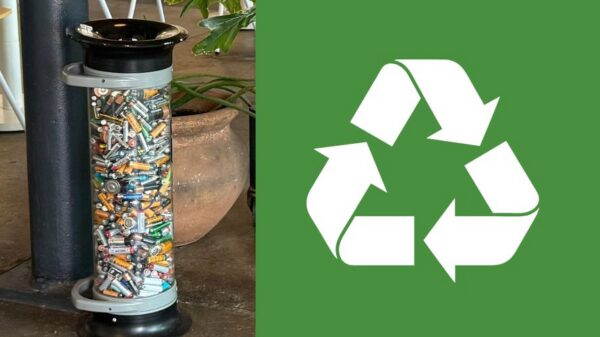
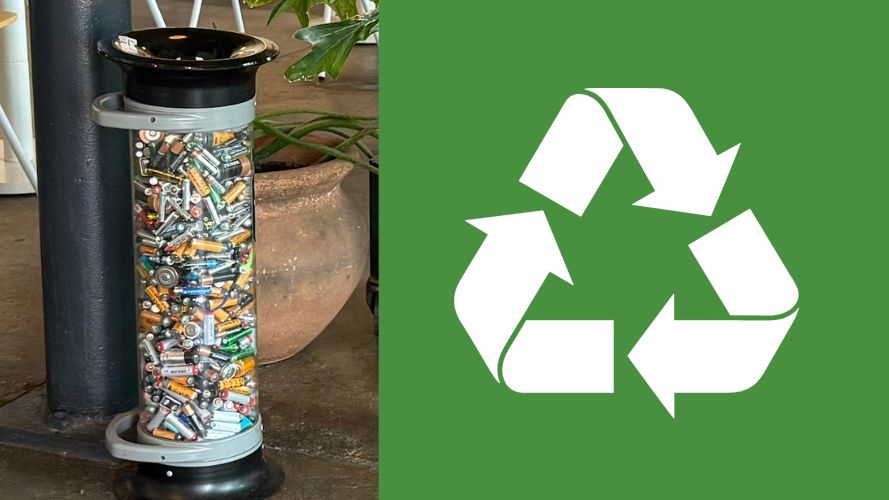
At Not Just Coffee, the usual rhythm of espresso drinks, laptop work sessions and café conversation plays out as expected. But near the counter, tucked into an unassuming corner, sits something slightly out of place: a battery drop box.
It is not part of the typical coffee shop experience, yet it represents a growing effort to make sustainability more accessible in everyday spaces.
Not Just Coffee, a family-founded business established in 2011, has expanded into multiple locations across Charlotte, along with a sister brand that includes its roastery, Night Swim Coffee. But beyond its role in the city’s coffee scene, the business has taken on a quieter environmental initiative.
In an email interview, the woman behind these drop boxes, Miracle Yoder, said the idea came from her youngest son, Adrian.
“Years ago, he wanted to start a project that was beneficial to the environment and involved the community.” Yoder said her son has always been passionate about the environment.
What began as a personal project, the battery drop box idea grew into something customers could participate in, with placements located at Not Just Coffee’s Jay Street location and another at Atherton Mill in South End.
While batteries are small, their environmental impact can be significant. Many household batteries contain materials like lithium, lead and cadmium. When thrown in the trash, they can end up in landfills where they can leak chemicals into soil and groundwater.
There are also safety concerns.
Lithium-ion batteries, commonly used in electronics, can spark fires if damaged or improperly disposed of in waste systems.
Despite these risks, battery recycling is often overlooked. Unlike paper or plastic, many people are unsure where or how to properly dispose of used batteries.
That is where small-scale efforts like the one at Not Just Coffee come in – offering a convenient, visible option for customers who might not otherwise recycle them.
According to Yoder, the battery drop box did not immediately gain traction and took some time to catch on, but once it did both locations have become popular for recycling patrons. “Both fill up very quickly these days,” she said.
The Jay Street location, in particular, tends to fill faster. Yoder attributes that, in part, to the coworking space located in the same building, which brings in a steady flow of people throughout the day.
At the Atherton Mill location, the process is slower, but still consistent. Overall, Yoder said it is difficult to tell whether customers come specifically to recycle batteries or simply use the drop box while already visiting the café. She thinks it is a combination of both.
The boxes themselves require minimal upkeep, typically needing to be emptied every two to three months.
For customers interested in participating, the process is simple. Small household batteries – such as AA, AAA, and many rechargeable batteries – can be placed directly into designated drop boxes like the one at Not Just Coffee.
Experts recommend storing batteries safely before recycling, including taping the ends of certain types like lithium batteries to prevent sparks. Damaged batteries should be handled carefully and kept separate.
Most importantly, batteries should not be thrown loosely into the trash, where they can pose both environmental and safety risks.
Larger batteries require a different approach. Items like car batteries, laptop batteries and e-bike batteries should not be placed in small drop boxes and instead need to be taken to specialized recycling locations.
In Charlotte, several options are available:
Checking ahead for specific guidelines is recommended, as accepted battery types can vary by location.
Yoder acknowledged that the impact of the battery drop box may seem limited on its own.
“I’m sure it’s a drop in the bucket in the grand scheme of things,” she said. “But every little bit helps when it comes down to the planet.”
Still, she believes the initiative is worthwhile, especially when viewed as part of a broader collective effort.
“If everyone picks one thing to try to make a small difference – together we can make a big difference,” she said.
Back at Not Just Coffee, the battery drop box continues to fill up. It may not change the world overnight, but it offers a simple, practical way for Charlotte residents to take part in sustainability – right alongside their daily coffee routine.
Queens University News Service stories are prepared by students in the James L. Knight School of Communication with supervision and editing from faculty and staff. The James L. Knight School of Communication at Queens University of Charlotte provides the news service in support of local community news.