Legacy is not simply what an institution leaves behind, but what it chooses to carry forward.
The merger between Queens University of Charlotte and Elon University marks a new chapter in the legacy of both institutions. But as Queens looks toward the future, questions emerge about the history it carries—and the role its archives play in preserving it.
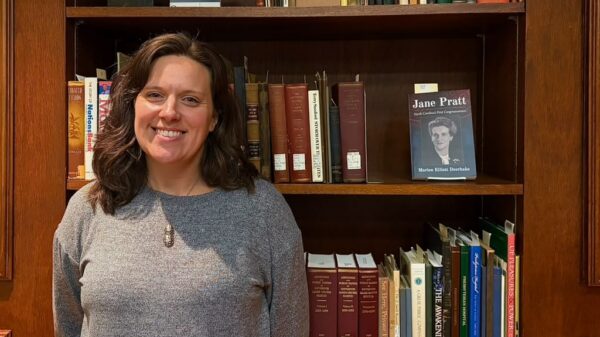
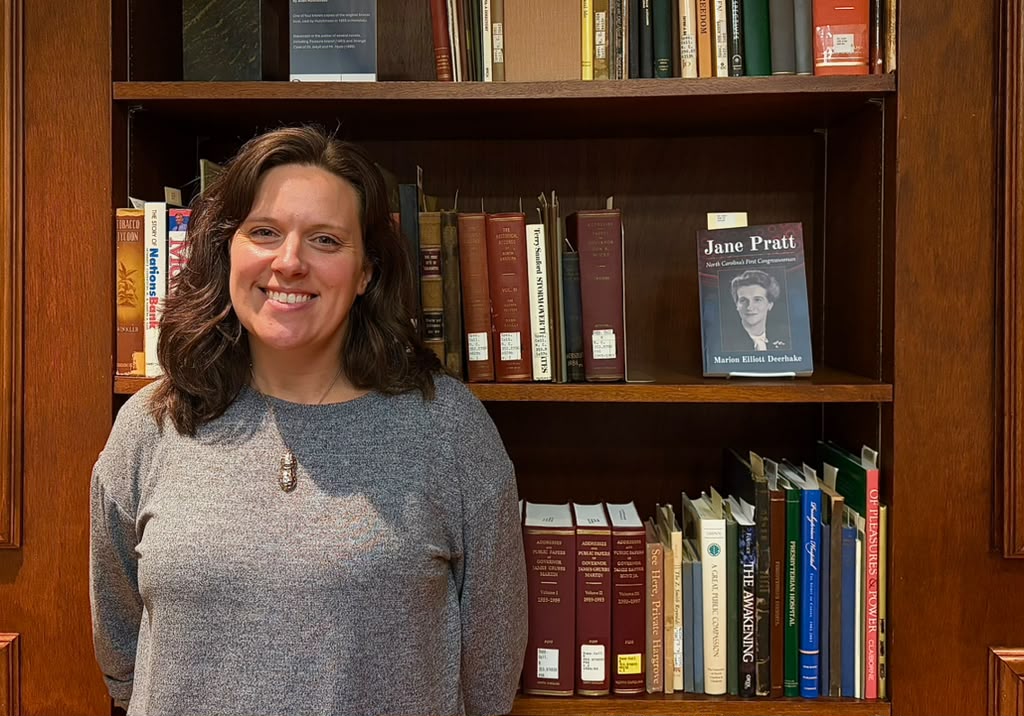
A photograph, a handwritten letter, a yearbook from years ago. Behind them is someone responsible for making sure that past is not lost. At Queens, this duty falls on Sarah Sowa.
As the university’s archivist, Sowa oversees approximately 2,500 linear feet of archival and special collections materials housed across seven rooms at Everett Library. Her job with the library archives, as she puts it, “goes from cradle to grave,” ranging from expanding the archival collection, accepting donations and evaluating existing collections to digitizing materials, deciding when to get rid of things and providing access in various ways.
“Every day is different and crazy as far as who I’m working with and what I’m doing,” Sowa said.
Sowa is also an assistant librarian at Queens, supporting general library operations however needed, even when it does not involve the archives at all. This is especially true right now as the library is understaffed. Other than Sowa, there are only Andrea Stanfield, assistant dean of the library, a part-time evening person and a few student workers.
“One person was let go because they were deemed redundant because of the merger, and then two people just happened to decide to leave for other opportunities around the same time,” Sowa said. “So, it really, really wiped out the library.”
However, more help is on the way. A new full-time manager is expected to join the team beginning in November, overseeing student workers and handling general operations. According to Sowa, the library is also in the process of hiring a librarian for a one-year appointment who will assist with more specialized responsibilities.
About the Merger
Elon University and Queens University of Charlotte announced their intention to merge in September 2025, proposing to combine their resources and strengths while expanding educational opportunities in Charlotte. The merger was approved by both universities’ boards in December of that year and reached a significant milestone in June 2026, when the Southern Association of Colleges and Schools Commission on Colleges approved the change, allowing Elon to assume governance of Queens.
In September 2026, one year after the initial announcement, the institutions unveiled the new name: Elon University | Queens College. As of November 2026, the merger remains in progress, with federal review by the U. S. Department of Education and additional operational decisions still pending.
Inside Queens’ Archives
The merger has brought changes, as well as new opportunities to the work of the Queens’ archivist. For example, Sowa’s title changed following the merger. She is no longer the archives and special collections librarian. Instead, she will serve as the archivist and assistant librarian moving forward.
“But my day-to-day activities really haven’t changed aside from blending in, making some time to connect with Elon folks and work on some things,” Sowa said, “like … a collective strategic plan for the next three to 10 years for the archives.”
Previously the sole archivist at Queens, Sowa is now excited about having a team. Even though they are far away, she meets with her Elon counterparts, including Shaunta Alvarez, the university archives coordinator at Elon and Sowa’s new direct supervisor, every Tuesday morning through Zoom.
In terms of resources, what might be the most exciting for Sowa is moving Queens’ digital collection from ContentDM, a widely used but, according to Sowa, outdated platform, to TIND. She said TIND is a better suited digital repository that has been adopted by institutions like UNC Charlotte, Charlotte-Mecklenburg Library, Wake Forest University and, most recently, Elon University.
“So as soon as the merger is complete and we can take a look at our contracts, we will be getting on board with their system, and then we’ll have that really nice user interface and more storage, and it’s going to be awesome,” Sowa said.
Inside Elon’s Archives
From Elon’s side, Archivist and Assistant Librarian Randall Bowman, one of the university’s three archivists, is excited to welcome a new colleague to the team.
“Sarah’s great. Yeah. In fact, we have a bunch of new colleagues because Queens has now basically become part of Elon, even though the process is not finished,” Bowman said.
Although the merger is progressing quickly, collaboration between the two archival teams remains in its early stages. This makes it difficult to predict how their work will become more interconnected in the future. But, according to Bowman, Sowa and the Elon team have talked around some ideas for future joint ventures, but none have been concreted.
While broader joint projects remain in the planning stages, the teams are already discussing ways to share digital resources beyond the planned transition to TIND.
“We have a program called ArchivesSpace, which is an online web resource that allows us to organize all of our collections, our items, everything,” Bowman said. “And we’re already talking about making this resource available to Queens.”
ArchivesSpace would provide a new digital space for internally organizing Queens’ archives and developing “finding aids.” These documents guide researchers through archival collections, providing information about their origins, contents and organization.
Beyond discussions about shared resources, the teams have also had opportunities to become familiar with each other’s collections through onsite visits.
“I’ve been down there,” Bowman said. “I’ve seen some of what they have, and it’s really pretty amazing.”
Readers interested in Elon’s archives can explore Elon’s digital collection to see examples of the materials the university preserves.
One future, two archival collections
This merger does not mean bringing both institutions’ histories under one collection.
“We’re still going to be delineating our individual legacies and collections because… we have unique stories to tell, and Elon is committed to respecting our culture and our history,” Sowa said. “And I think a big part of that is maintaining, growing our archives and continuing to share them in a way that is representative of the Queens story.”
According to Sowa, the possibility of combining Queens’ and Elon’s collection was discussed at the beginning of the merger planning. It was ultimately decided that the physical materials in Queens archives would remain at Queens, within reach of the institution’s stakeholders and community.
And, although the institutions will begin sharing digital tools and Queens’ digital collection will migrate to TIND, the archives of both universities will remain separate, housed side by side within the same platform.
“It wouldn’t make sense for us to merge our archives because we are two distinct institutions,” Bowman said.
Beyond the merger, other new and exciting changes are coming to the Everett Library. For instance, Sowa is exploring new ways to make archival work more efficient. In collaboration with Nathan Michalewickz, Ph.D., a professor of history and data analytics at Queens, Sowa is developing an AI project for rapidly processing materials by photographing them.
“We started planning it, I think, over the summer,” Sowa said. “We have everything ready, and we’ve done a little test run. So, we’re really ready to go … I think we’re going to probably start either in the spring or in the summer.”
In the meantime, Queens’ archives remain open to students of the two institutions and the broader community. Sowa is happy to accommodate walk-in visitors; however, there is little that is accessible without an appointment. Those interested in exploring Queens’ archives can contact Sowa directly or submit a research appointment request through the library’s website.
“I would just invite people to ask questions,” Sowa said. “Don’t be afraid to check the archives out … libraries and archives are meant for everybody, and I really mean that.”
Queens University News Service stories are prepared by students in the James L. Knight School of Communication with supervision and editing from faculty and staff. The James L. Knight School of Communication at Queens University of Charlotte provides the news service in support of local community news.